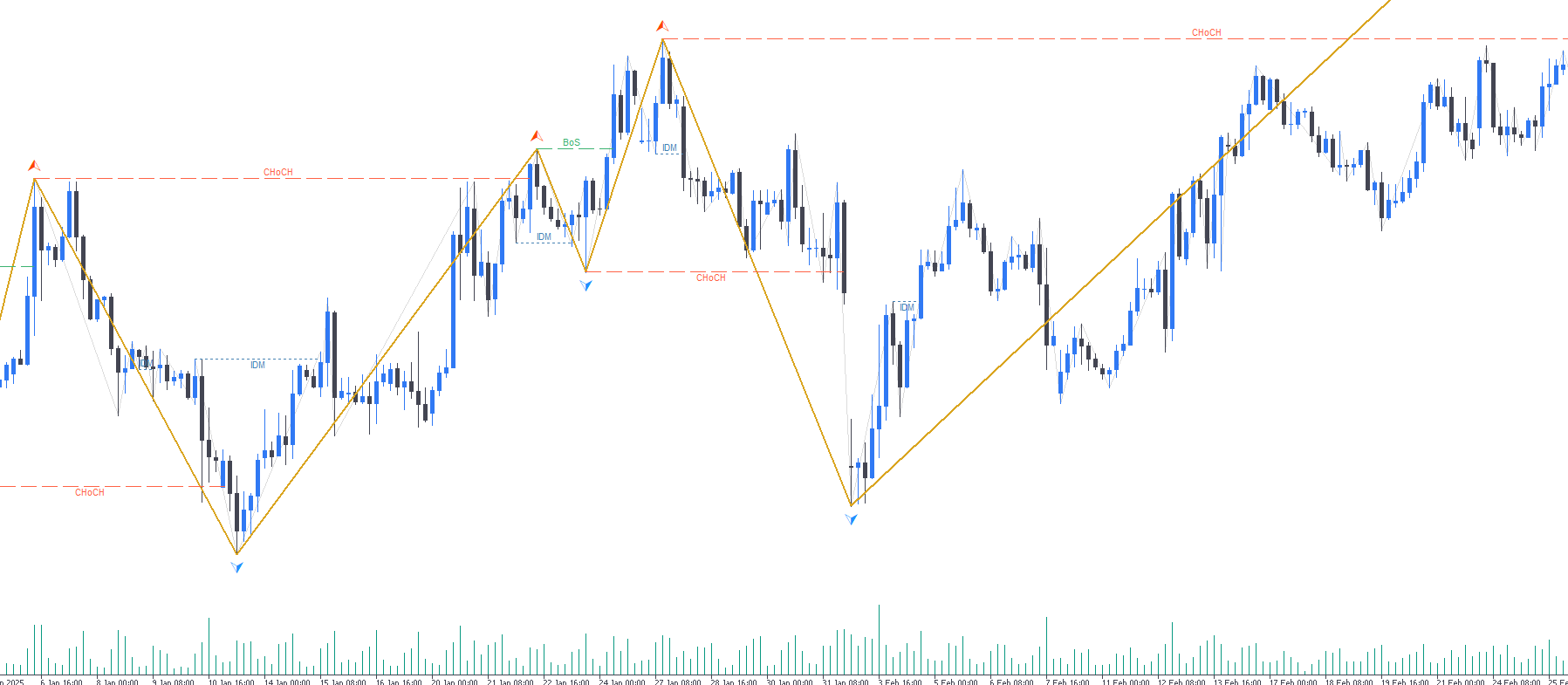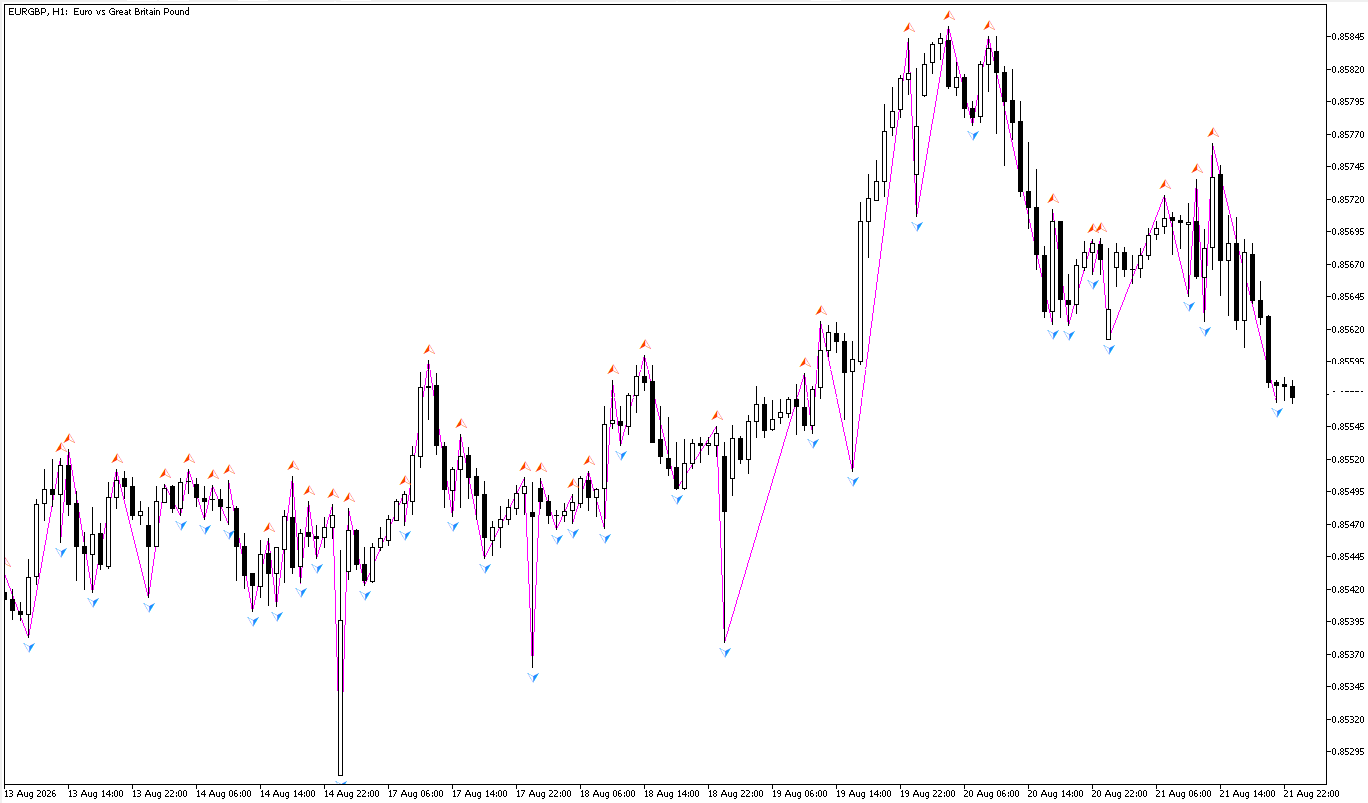
Smart Money Concept Expert Advisor — Market Structure, FVG, Pullback
This Expert Advisor trades fair value gaps in the direction of market structure, the way Smart Money Concepts describes it. It is the third step of a series that has been built one piece at a time: In previous shared codes, the SMC Pullback Indicator decided which highs and lows matter, the SMC Market Structure indicator turned those swings into a trend with BoS, CHoCH, IDM and liquidity sweeps, and this EA trades the result.
The structure engine is not reimplemented here. Both classes are included from SmcMarketStructure.mqh, the same code the indicator draws from, so what the EA acts on and what you see on the chart cannot disagree.
Read this before anything else: this EA is not a profitable system, and it is not presented as one.
Its purpose is to show how market structure and fair value gaps can be wired into a working Expert Advisor — how a BoS arms a setup, how an IDM confirms a leg, how gaps are found and filtered, how a structural stop turns into a position size. It is a teaching skeleton and a starting point, not a finished strategy.
A robust, genuinely profitable SMC strategy needs far more than what is here: multi-timeframe context so the lower timeframe is read in the direction of the higher one, pattern detection beyond a single gap type, proper risk and money management across trades rather than one fixed percent, order blocks and order flow, and entry rules considerably more selective than a first touch. Each of those is a project in itself.
What this code gives you is a clean, readable base with the structure engine already solved, so you can bolt your own proven ideas on top instead of starting from an empty file. Treat every default as a placeholder and test everything yourself.
The setup
Four things have to line up before a long trade. The short side is the exact mirror and is never described separately below.
| # | Condition | Why it is there |
|---|---|---|
| 1 | The trend is up and the last structural break was a BoS | Only continuation is traded. After a CHoCH the EA stands down completely until the first BoS of the new trend arrives. |
| 2 | That BoS marks the gaps | The scan runs once, from the structure low rightward to the breaking bar. Those gaps, and only those, are tradable. |
| 3 | The structure high is confirmed — price has taken the IDM | Until the inducement is taken the leg has no known high, so there is nothing to measure a retracement against. |
| 4 | Price trades back into a gap, deep enough into the leg | That touch is the entry. The depth filter throws away the shallow ones. |

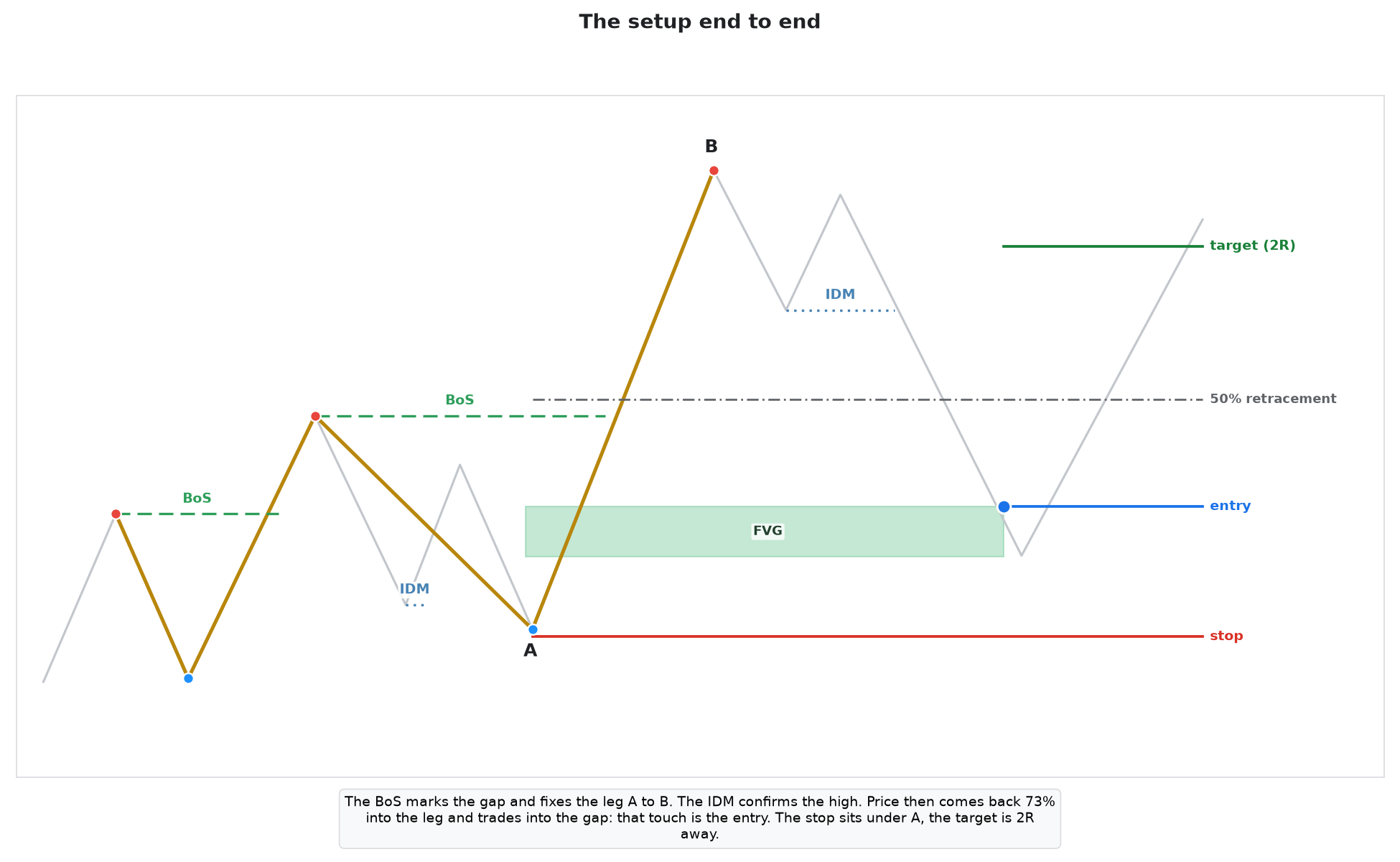
Everything in that figure is produced by the EA logic itself, not drawn by hand. The pale line is the pullback swings, the gold line is the structure, and A and B are the two points every later calculation refers to: A is the structure low the leg started from and B is the high the IDM confirmed.

What counts as a fair value gap
A gap is a three-candle pattern. The middle candle travels far enough that the third candle never trades back to the first, leaving a band of price that was skipped:
Bullish gap: the low of candle 3 is above the high of candle 1. Bearish gap: the high of candle 3 is below the low of candle 1. The band between those two levels is the gap.

Finding gaps is easy; the useful part is deciding which ones matter. Three filters apply, and a gap has to pass all of them:
- Position. It must sit between the structure low and the bar that broke the level. Gaps older than the leg belong to a move that is already finished.
- Side. It must lie entirely below the level the BoS broke. A gap above that level is not a discount, it is chasing.
- Size. It must be at least the minimum width you set, in points or pips. This is the only noise filter in the strategy, and on a low timeframe it is the one that matters.
Each surviving gap is drawn as a box labelled FVG, and the box extends to the right with every new candle until price touches it. Once touched it stops growing, which leaves a visible record of how long the gap stood untested.
How deep price has to come back
A gap right under the high is a weak place to buy. Price has barely corrected, the move has not been tested, and the stop has to sit a long way off. The depth filter exists to refuse exactly that.
The leg is A to B. Depth is measured from B back towards A, so 0% is the confirmed high and 100% is the structure low itself. Set the minimum to 50% and price must return at least to the midpoint of the leg before any gap in it may be traded.

In the figure the touch arrives at 73% of the leg, past the 50% threshold, so it is allowed. Had the gap sat in the shaded band near B it would have been refused no matter how clean it looked. Setting the input to 0 turns the filter off.
Touching a gap and using a gap are not the same thing. A gap entered at its upper edge may still be too shallow, and price can come deeper into the same gap a few candles later. So a touched gap stops extending but stays live, and is reconsidered on every tick until it either trades or is traded straight through.
Entry, stop and target
The touch is the entry, at market. The rest follows from the structure rather than from a fixed distance:
| Level | Where it comes from |
|---|---|
| Entry | The moment price trades into the gap, long at the ask. |
| Stop | The structure low A, less a buffer you set in points or pips. If the low breaks, the reason for the trade is gone. |
| Target | A fixed multiple of the risk. With R set to 2, the target is twice the entry-to-stop distance. |

Because the stop is structural, its distance varies from trade to trade — and that is the point. The position size is worked out from the percent of balance you are willing to lose, so a tight stop buys a larger position and a wide one a smaller position, and every trade risks the same money. A fixed lot is available but it is not the default, because it would make a tight stop and a wide stop mean completely different things.
Two guards sit in front of every order: the EA refuses the trade if the stop would land on the wrong side of price, and if the distance is inside the broker's stop level. If the smallest tradable volume would risk more than your percentage allows, it says so in the log rather than quietly risking more.
Managing the position
Once a trade is open, two optional rules can move its stop. Both live in a separate class, CPositionManager, which knows nothing about market structure or gaps — only a symbol and a magic number — so it can be reused in any EA.
They share one rule that is not optional:
A stop only ever moves forward. Break even and trailing each propose a level, the better of the two wins, and the result is thrown away unless it improves on the stop already in place. A stop that can retreat is not a stop.
| Rule | Setting | What it does |
|---|---|---|
| Break even | Trigger | How far the trade must be in profit before the stop is moved to entry. |
| Offset | How far beyond entry the stop lands. An offset above zero locks a little profit instead of leaving a true scratch, and covers the spread and commission. | |
| Trailing | Trigger | How far in profit the trade must be before trailing begins at all. |
| Step | The smallest improvement worth a modify. Without it the stop would be rewritten on nearly every tick for a fraction of a point. | |
| Distance | How far behind price the stop is held once trailing is running. |
Both triggers and distances are read in the same unit as the rest of the EA — points or pips, whichever you selected. The two rules work together: break even typically fires first and parks the stop at entry, then trailing takes over as the move extends. A level the broker would reject for being too close to price is skipped rather than retried.
Standing down after a CHoCH
A CHoCH is the structure admitting the trend has turned. The EA does not treat it as a signal to trade the other way immediately — it clears every gap it was watching and does nothing at all until the first BoS in the new direction confirms the reversal has follow-through. This is the single biggest difference between it and a naive FVG bot, and it is what keeps it out of a range that is chopping back and forth.
A new BoS in the same direction has a similar effect on a smaller scale: the previous gaps are discarded and the scan runs again. Only the current leg is ever traded.
Inputs
Structure engine
These four match the indicator exactly. If you run both, keep them the same or the chart and the EA will be looking at different structures.
| Input | Default | What it does |
|---|---|---|
| Start by looking for | Swing high | Which side the first pullback leg searches for. Only affects the oldest bars. |
| Pullback break confirmed by | Wick | The sensitivity control for everything downstream. Close gives fewer, larger swings and therefore fewer, larger legs. |
| IDM taken when reference is | Wick | Whether the inducement has to be touched or closed through. |
| Bars of history to build on | 3000 | The structure is rebuilt from scratch every bar over this window, so bar indices can never drift as history loads. |
Fair value gaps
| Input | Default | What it does |
|---|---|---|
| Distance inputs are in | Points | Applies to the gap size and the stop buffer. Pips is ten points on a 3 or 5 digit symbol. |
| Minimum gap size | 50 | Gaps narrower than this are ignored. Raise it on a noisy symbol; 0 accepts every gap. |
| Only trade once the IDM is taken | true | Turning it off trades gaps as soon as the BoS marks them, without waiting for the leg to be confirmed. More trades, weaker ones. |
Trading
| Input | Default | What it does |
|---|---|---|
| Take profit, in R | 2.0 | Target as a multiple of the entry-to-stop distance. |
| Stop buffer beyond the structure | 20 | How far under A the stop hides, in your chosen unit. |
| Minimum retracement into the leg | 50% | The depth filter described above. 0 turns it off. |
| Max open positions | 1 | 1 means one trade at a time. Raise it and several gaps in the same leg can each take a trade — a gap never trades twice. |
| Position size from | Risk percent | Percent of balance risked on the stop, or a fixed lot. |
| Risk per trade | 1.0% | Of balance, measured against the actual stop distance. |
Break even and trailing
| Input | Default | What it does |
|---|---|---|
| Move the stop to break even | true | Turns the break even rule on. |
| Profit that arms it | 100 | Profit needed before the stop jumps to entry. |
| Offset beyond entry | 10 | Where the stop lands relative to entry. Keep it above your spread and commission. |
| Trail the stop | true | Turns trailing on. |
| Profit before trailing starts | 150 | Set it above the break even trigger so the two hand over cleanly. |
| Smallest move worth making | 20 | Minimum improvement before the stop is modified. |
| Distance held behind price | 100 | Too tight and the trail will take you out of a healthy pullback. |
The display group controls the gap boxes and the structure drawing. Turn the structure off for long optimisation runs — it redraws several hundred objects a bar, which is fine visually and wasteful otherwise.
What to know before running it
- Closed bars only. The structure is evaluated on closed candles; the forming candle is never used. Entries are checked on every tick, because a gap can be touched mid-candle.
- The structure repaints, by design. A pending extreme moves until its IDM is taken, and a liquidity sweep relocates a point backwards. Trades are only taken from confirmed legs, so this does not move a stop after the fact — but the picture before confirmation is provisional and is meant to be.
- It is a continuation strategy. It will sit out reversals entirely, and in a long range it will stand down after the first CHoCH and stay down.
- Trade management is deliberately plain. One entry, one target, and an optional break even and trailing stop. There are no partial closes, no scaling in, no grid and no recovery logic, because the point is to see whether the structure plus gap premise does anything on its own rather than to bury it under management.
- Test it before you believe it. There are no tuned parameters here and no presented backtest. The defaults are reasonable starting points, not recommendations.
Testing
below represent a backtest results of EA in the Tester Mode on XAUUSD-M15

Files
| File | Contents |
|---|---|
| SMC_StructureFVG_EA.mq5 | The EA: the gap scan, the filters, the trade and the drawing. |
| PositionManager.mqh | Break even and trailing. Depends on nothing in this EA beyond a symbol and a magic number. |
| SmcMarketStructure.mqh | The two structure engines, unchanged from the indicator. Neither class touches a buffer or a chart object, so they drop into any EA that wants a trend, a structure chain and an event list. |
Put all three in the same folder and compile the .mq5; the includes are relative, so there is nothing to install anywhere else.
Source code
Copy the code into MetaEditor, save it as SMC_StructureFVG_EA.mq5 and compile (F7).
//+-------------------------------------------------------------------+
//| SMC_StructureFVG_EA.mq5|
//| Copyright 2026, Sandro Begashvili |
//| https://www.mql5.com/en/users/sandrobegashvil |
//| https://t.me/rhinoquant |
//| |
//| Trades fair value gaps in the direction of the market structure |
//| produced by SmcMarketStructure.mqh - the same engine the SMC |
//| Market Structure indicator draws. |
//| |
//| The setup, long side (short is the mirror): |
//| |
//| 1. Trend is UP and the last structural break was a BoS. After a |
//| CHoCH the EA stands down until the first BoS of the new |
//| trend arrives. |
//| 2. The BoS marks the gaps: scan from the structure LOW rightward|
//| and record every bullish FVG that is wide enough and sits |
//| below the broken level. |
//| 3. The structure high is confirmed - price has taken the IDM. |
//| 4. Price trades back into one of those gaps. That is the entry. |
//| |
//| Stop loss is the structure low less a buffer; take profit is a |
//| multiple of that risk. A gap trades at most once, and a new BoS |
//| discards every gap left over from the previous leg. |
//+-------------------------------------------------------------------+
#property copyright "Copyright 2026, Sandro Begashvili"
#property link "https://www.mql5.com/en/users/sandrobegashvil"
#property version "1.00"
#property description "Trades fair value gaps in the direction of SMC market structure."
#property description "BoS marks the gaps, the IDM confirms the leg, the gap is the entry."
#property description "Telegram: https://t.me/rhinoquant"
#include <Trade/Trade.mqh>
#include "SmcMarketStructure.mqh"
#include "PositionManager.mqh"
//--- how distance inputs are read
enum ENUM_DIST_UNIT
{
DIST_POINTS, // Points
DIST_PIPS // Pips (10 points on a 3 / 5 digit symbol)
};
//--- how the position size is decided
enum ENUM_LOT_MODE
{
LOT_RISK, // Percent of balance risked on the stop
LOT_FIXED // Fixed lot
};
input group "Structure engine"
input ENUM_LOOKING_FOR InpStartSide = LOOK_HIGH; // Start by looking for
input ENUM_BREAK_MODE InpBreakMode = BREAK_BY_WICK; // Pullback break confirmed by
input ENUM_TOUCH_MODE InpTouchMode = TOUCH_BY_WICK; // IDM taken when reference is
input bool InpUseSweeps = true; // Detect liquidity sweeps
input int InpHistoryBars = 3000; // Bars of history to build on
input group "Fair value gaps"
input ENUM_DIST_UNIT InpDistUnit = DIST_POINTS; // Distance inputs are in
input double InpFvgMinSize = 50; // Minimum gap size (0 = any)
input bool InpRequireIdm = true; // Only trade once the IDM is taken
input bool InpFvgBelowBos = true; // Keep only gaps on the near side of the broken level
input bool InpFvgLogSkips = false; // Log every gap candidate and why it was skipped
input bool InpShowFvg = true; // Draw the gaps
input color InpFvgBuyColor = clrSeaGreen; // Bullish gap colour
input color InpFvgSellColor = clrIndianRed; // Bearish gap colour
input color InpFvgTextColor = clrWhite; // Gap caption colour
input int InpFvgTextSize = 8; // Gap caption size
input group "Structure display"
input bool InpShowStruct = true; // Draw the structure the EA sees
input color InpPbLegColor = clrGainsboro; // Pullback zigzag
input color InpMsLegColor = clrGoldenrod; // Structure zigzag
input color InpHighColor = clrOrangeRed; // Structure high marker
input color InpLowColor = clrDodgerBlue; // Structure low marker
input color InpBosColor = clrMediumSeaGreen; // BoS
input color InpChochColor = clrTomato; // CHoCH
input color InpSweepColor = clrMediumOrchid;// Liquidity sweep
input color InpIdmColor = clrSteelBlue; // IDM
input color InpDepthColor = clrDarkGray; // Minimum-retracement level
input group "Trading"
input bool InpAllowBuy = true; // Allow long trades
input bool InpAllowSell = true; // Allow short trades
input double InpRiskReward = 2.0; // Take profit, in R
input double InpSlBuffer = 20; // Stop buffer beyond the structure
input double InpMinDepth = 50.0; // Minimum retracement into the leg (%, 0 = off)
input int InpMaxPositions = 1; // Max open positions (1 = one at a time)
input ENUM_LOT_MODE InpLotMode = LOT_RISK; // Position size from
input double InpRiskPercent = 1.0; // Risk per trade (% of balance)
input double InpFixedLot = 0.01; // Fixed lot (only when sizing is fixed)
input ulong InpMagic = 20261010; // Magic number
input ulong InpSlippage = 20; // Slippage (points)
input group "Break even"
input bool InpBeEnable = true; // Move the stop to break even
input double InpBeTrigger = 100; // Profit that arms it
input double InpBeOffset = 10; // Offset beyond entry (lock-in)
input group "Trailing stop"
input bool InpTrailEnable = true; // Trail the stop
input double InpTrailTrigger = 150; // Profit before trailing starts
input double InpTrailStep = 20; // Smallest move worth making
input double InpTrailDist = 100; // Distance held behind price
//+-------------------------------------------------------------------+
//| One fair value gap |
//| |
//| Keyed by the TIME of its first candle, not a bar index: the |
//| structure is rebuilt from scratch on every bar, so indices move |
//| but times do not. |
//+-------------------------------------------------------------------+
struct FvgBox
{
datetime t_open; // first candle of the three
datetime t_right; // right edge, walks forward until touched
double top;
double bottom;
bool bullish;
bool frozen; // price has touched it: stop extending
bool spent; // already traded, or mitigated without a trade
string name;
};
CTrade Trade;
CPositionManager Manager;
FvgBox Fvgs[];
string ObjPrefix = "";
datetime LastBarTime = 0;
datetime ActiveBosTime = 0; // the BoS the current gaps belong to
int ActiveDir = 0; // +1 long setup, -1 short, 0 stood down
double StructLow = 0.0; // the levels a stop hides behind, as of
double StructHigh = 0.0; // the last closed bar
bool LegConfirmed = false; // the extreme has taken its IDM
double PointSize = 0.0;
double UnitSize = 0.0; // one input unit, in price
double WarnedFree = -1.0; // free margin the funds notice last reported
datetime EntryBlockedBar = 0; // a send failed on this bar: stand down
//--- the slice of free margin the EA refuses to spend, so that spread,
//--- commission and the next tick cannot turn an accepted order into a
//--- margin call
const double MarginReserve = 0.05; // 5%
//--- the price history the engines run on, oldest first
double H[], L[], C[];
datetime T[];
//--- the pullback swings of the last rebuild, kept only for drawing
SwingPoint PbSwings[];
//+-------------------------------------------------------------------+
int OnInit(void)
{
ObjPrefix = StringFormat("SFVG_%I64d_", ChartID());
PointSize = SymbolInfoDouble(_Symbol, SYMBOL_POINT);
const int digits = (int)SymbolInfoInteger(_Symbol, SYMBOL_DIGITS);
const double pip = (digits == 3 || digits == 5) ? PointSize * 10.0 : PointSize;
UnitSize = (InpDistUnit == DIST_PIPS) ? pip : PointSize;
Trade.SetExpertMagicNumber(InpMagic);
Trade.SetDeviationInPoints((ulong)InpSlippage);
Trade.SetTypeFillingBySymbol(_Symbol);
//--- the stop manager speaks the same distance unit as everything else
Manager.Configure(_Symbol, InpMagic, UnitSize, InpSlippage);
Manager.SetBreakEven(InpBeEnable, InpBeTrigger, InpBeOffset);
Manager.SetTrailing(InpTrailEnable, InpTrailTrigger, InpTrailStep, InpTrailDist);
if(InpRiskReward <= 0.0)
{
Print("Risk / reward must be greater than zero.");
return(INIT_PARAMETERS_INCORRECT);
}
if(InpMaxPositions < 1)
{
Print("Max open positions must be at least 1.");
return(INIT_PARAMETERS_INCORRECT);
}
if(InpMinDepth < 0.0 || InpMinDepth > 100.0)
{
Print("Minimum retracement must be between 0 and 100 percent.");
return(INIT_PARAMETERS_INCORRECT);
}
ArrayResize(Fvgs, 0);
LastBarTime = 0;
ActiveBosTime = 0;
ActiveDir = 0;
WarnedFree = -1.0;
EntryBlockedBar = 0;
return(INIT_SUCCEEDED);
}
//+-------------------------------------------------------------------+
void OnDeinit(const int reason)
{
ObjectsDeleteAll(0, ObjPrefix);
ChartRedraw();
}
//+-------------------------------------------------------------------+
//| Loads the history and runs both engines over it from scratch. |
//| |
//| Rebuilding every bar rather than stepping incrementally keeps the |
//| EA honest: bar indices cannot drift as history loads or shifts, |
//| and what the EA sees is exactly what the indicator would draw on |
//| the same chart. The engines are linear, so the cost is noise. |
//+-------------------------------------------------------------------+
bool BuildStructure(CMarketStructure &ms)
{
const int want = MathMin(InpHistoryBars, Bars(_Symbol, _Period));
if(want < 50)
return(false);
ArraySetAsSeries(H, false);
ArraySetAsSeries(L, false);
ArraySetAsSeries(C, false);
ArraySetAsSeries(T, false);
if(CopyHigh(_Symbol, _Period, 0, want, H) != want)
return(false);
if(CopyLow(_Symbol, _Period, 0, want, L) != want)
return(false);
if(CopyClose(_Symbol, _Period, 0, want, C) != want)
return(false);
if(CopyTime(_Symbol, _Period, 0, want, T) != want)
return(false);
CPullbackDetector pb;
pb.Configure(InpStartSide, InpBreakMode);
ms.Configure(InpTouchMode, InpUseSweeps);
ArrayResize(PbSwings, 0);
const int last_closed = want - 2; // the forming bar is never used
for(int i = 0; i <= last_closed; i++)
{
SwingPoint swing;
const bool have = pb.Step(i, H, L, C, swing);
if(have)
{
const int n = ArraySize(PbSwings);
ArrayResize(PbSwings, n + 1);
PbSwings[n] = swing;
}
ms.Step(i, H, L, C, have, swing);
}
return(true);
}
//+-------------------------------------------------------------------+
//| The newest BoS or CHoCH, ignoring IDM and sweep events. |
//+-------------------------------------------------------------------+
bool LastBreak(CMarketStructure &ms, MsEvent &out)
{
for(int k = ms.Events() - 1; k >= 0; k--)
{
MsEvent e;
ms.Event(k, e);
if(e.type == MS_EVENT_BOS || e.type == MS_EVENT_CHOCH)
{
out = e;
return(true);
}
}
return(false);
}
//+-------------------------------------------------------------------+
void ClearFvgs(void)
{
for(int i = 0; i < ArraySize(Fvgs); i++)
{
ObjectDelete(0, Fvgs[i].name);
ObjectDelete(0, Fvgs[i].name + "t");
}
ArrayResize(Fvgs, 0);
}
//+-------------------------------------------------------------------+
//| Collects the gaps a fresh BoS makes available. |
//| |
//| The scan walks from the structure low (high, when short) rightward|
//| to the breaking bar. A gap only qualifies if it is wide enough |
//| and sits entirely on the near side of the level that was broken - |
//| a gap above a bullish BoS is not a discount, it is chasing. |
//+-------------------------------------------------------------------+
void ScanFvgs(CMarketStructure &ms, const bool bullish, const int bos_bar,
const double bos_price, const int to_bar, const bool reset)
{
if(reset)
ClearFvgs();
const int from = bullish ? ms.LowIndex() : ms.HighIndex();
if(from < 0 || to_bar <= from)
return;
const double min_size = InpFvgMinSize * UnitSize;
int seen = 0, too_small = 0, wrong_side = 0;
//--- i is the third candle of the pattern, so it starts two on
for(int i = from + 2; i <= to_bar; i++)
{
double top, bottom;
if(bullish)
{
if(!(L[i] > H[i - 2])) // no gap between candle 1 and 3
continue;
bottom = H[i - 2];
top = L[i];
}
else
{
if(!(H[i] < L[i - 2]))
continue;
bottom = H[i];
top = L[i - 2];
}
seen++;
if(FvgKnown(T[i - 2]))
continue; // already on the books
if(top - bottom < min_size)
{
too_small++;
if(InpFvgLogSkips)
PrintFormat("gap at %s skipped: %.*f wide, minimum is %.*f",
TimeToString(T[i - 2]), _Digits, top - bottom,
_Digits, min_size);
continue;
}
if(InpFvgBelowBos && (bullish ? (top > bos_price) : (bottom < bos_price)))
{
wrong_side++;
if(InpFvgLogSkips)
PrintFormat("gap at %s skipped: %.*f-%.*f is on the far side of the broken %.*f",
TimeToString(T[i - 2]), _Digits, bottom, _Digits, top,
_Digits, bos_price);
continue;
}
const int n = ArraySize(Fvgs);
ArrayResize(Fvgs, n + 1);
Fvgs[n].t_open = T[i - 2];
Fvgs[n].t_right = T[i];
Fvgs[n].top = top;
Fvgs[n].bottom = bottom;
Fvgs[n].bullish = bullish;
Fvgs[n].frozen = false;
Fvgs[n].spent = false;
Fvgs[n].name = StringFormat("%sFVG_%I64d", ObjPrefix, (long)T[i - 2]);
DrawFvg(Fvgs[n]);
}
if(InpFvgLogSkips && reset)
PrintFormat("scan %d..%d: %d gap(s) found, %d too small, %d wrong side, %d kept",
from, to_bar, seen, too_small, wrong_side, ArraySize(Fvgs));
}
//+-------------------------------------------------------------------+
//| Gaps are keyed by the time of their first candle, so a rescan can |
//| add what is new without disturbing what is already being tracked. |
//+-------------------------------------------------------------------+
bool FvgKnown(const datetime t)
{
for(int i = 0; i < ArraySize(Fvgs); i++)
if(Fvgs[i].t_open == t)
return(true);
return(false);
}
//+-------------------------------------------------------------------+
//| Draws or updates one gap, caption centred in the box. |
//+-------------------------------------------------------------------+
void DrawFvg(FvgBox &f)
{
if(!InpShowFvg)
return;
const color clr = f.bullish ? InpFvgBuyColor : InpFvgSellColor;
if(ObjectFind(0, f.name) < 0)
{
ObjectCreate(0, f.name, OBJ_RECTANGLE, 0, f.t_open, f.bottom, f.t_right, f.top);
ObjectSetInteger(0, f.name, OBJPROP_COLOR, clr);
ObjectSetInteger(0, f.name, OBJPROP_FILL, true);
ObjectSetInteger(0, f.name, OBJPROP_BACK, true);
ObjectSetInteger(0, f.name, OBJPROP_SELECTABLE, false);
ObjectSetInteger(0, f.name, OBJPROP_HIDDEN, true);
}
ObjectSetInteger(0, f.name, OBJPROP_TIME, 0, f.t_open);
ObjectSetDouble(0, f.name, OBJPROP_PRICE, 0, f.bottom);
ObjectSetInteger(0, f.name, OBJPROP_TIME, 1, f.t_right);
ObjectSetDouble(0, f.name, OBJPROP_PRICE, 1, f.top);
//--- the caption follows the middle of the box as the box grows
const string lbl = f.name + "t";
const datetime mid_t = (datetime)((long)f.t_open / 2 + (long)f.t_right / 2);
const double mid_p = (f.top + f.bottom) / 2.0;
if(ObjectFind(0, lbl) < 0)
{
ObjectCreate(0, lbl, OBJ_TEXT, 0, mid_t, mid_p);
ObjectSetString(0, lbl, OBJPROP_TEXT, "FVG");
ObjectSetString(0, lbl, OBJPROP_FONT, "Arial");
ObjectSetInteger(0, lbl, OBJPROP_FONTSIZE, InpFvgTextSize);
ObjectSetInteger(0, lbl, OBJPROP_COLOR, InpFvgTextColor);
ObjectSetInteger(0, lbl, OBJPROP_ANCHOR, ANCHOR_CENTER);
ObjectSetInteger(0, lbl, OBJPROP_SELECTABLE, false);
ObjectSetInteger(0, lbl, OBJPROP_HIDDEN, true);
}
ObjectSetInteger(0, lbl, OBJPROP_TIME, 0, mid_t);
ObjectSetDouble(0, lbl, OBJPROP_PRICE, 0, mid_p);
}
//+-------------------------------------------------------------------+
//| How far price has to come back before a gap may be traded. |
//| |
//| The leg is A -> B: the structure low to the confirmed high when |
//| long, mirrored when short. Depth is measured from B back towards |
//| A, so 50% is the midpoint of the leg and 100% is A itself. A |
//| shallow touch near B is the weakest kind of entry, which is what |
//| this filter is there to refuse. |
//+-------------------------------------------------------------------+
double DepthLevel(const bool bullish)
{
const double a = bullish ? StructLow : StructHigh; // where the leg began
const double b = bullish ? StructHigh : StructLow; // the confirmed extreme
return(b - (b - a) * InpMinDepth / 100.0);
}
//+-------------------------------------------------------------------+
bool DepthOk(const bool bullish, const double price)
{
if(InpMinDepth <= 0.0)
return(true);
const double a = bullish ? StructLow : StructHigh;
const double b = bullish ? StructHigh : StructLow;
if(MathAbs(b - a) <= 0.0)
return(true); // degenerate leg, do not block
return(bullish ? (price <= DepthLevel(true))
: (price >= DepthLevel(false)));
}
//+-------------------------------------------------------------------+
int CountPositions(void)
{
int n = 0;
for(int i = PositionsTotal() - 1; i >= 0; i--)
{
const ulong ticket = PositionGetTicket(i);
if(ticket == 0 || !PositionSelectByTicket(ticket))
continue;
if(PositionGetString(POSITION_SYMBOL) == _Symbol &&
PositionGetInteger(POSITION_MAGIC) == (long)InpMagic)
n++;
}
return(n);
}
//+-------------------------------------------------------------------+
//| Volume for the requested risk, clamped to the symbol's limits. |
//+-------------------------------------------------------------------+
double PositionVolume(const ENUM_ORDER_TYPE type, const double entry, const double sl)
{
const double v_min = SymbolInfoDouble(_Symbol, SYMBOL_VOLUME_MIN);
const double v_max = SymbolInfoDouble(_Symbol, SYMBOL_VOLUME_MAX);
const double v_step = SymbolInfoDouble(_Symbol, SYMBOL_VOLUME_STEP);
if(InpLotMode == LOT_FIXED)
return(AffordableVolume(type, NormalizeVolume(InpFixedLot, v_min, v_max, v_step), entry));
//--- risk sizing: a tighter stop buys a bigger position for the same
//--- money, which is the whole point of placing the stop structurally
const double tick_value = SymbolInfoDouble(_Symbol, SYMBOL_TRADE_TICK_VALUE);
const double tick_size = SymbolInfoDouble(_Symbol, SYMBOL_TRADE_TICK_SIZE);
const double distance = MathAbs(entry - sl);
if(tick_value <= 0.0 || tick_size <= 0.0 || distance <= 0.0)
{
Print("Cannot size the trade: symbol tick data or stop distance is unusable.");
return(0.0);
}
const double loss_per_lot = distance / tick_size * tick_value;
if(loss_per_lot <= 0.0)
return(0.0);
const double risk = AccountInfoDouble(ACCOUNT_BALANCE) * InpRiskPercent / 100.0;
const double raw = risk / loss_per_lot;
const double lot = NormalizeVolume(raw, v_min, v_max, v_step);
//--- rounding up to the smallest tradable size would quietly risk more
//--- than asked for, so say so rather than hide it
if(lot * loss_per_lot > risk * 1.01)
PrintFormat("Minimum volume %.*f risks %.2f, above the %.2f requested (%.1f%% of balance).",
VolumeDigits(v_step), lot, lot * loss_per_lot, risk, InpRiskPercent);
//--- the size the risk asks for is worthless if the account cannot
//--- finance it; trimming only ever lowers the risk taken
return(AffordableVolume(type, lot, entry));
}
//+-------------------------------------------------------------------+
int VolumeDigits(const double step)
{
for(int d = 0; d <= 8; d++)
if(MathAbs(step * MathPow(10, d) - MathRound(step * MathPow(10, d))) < 1e-9)
return(d);
return(2);
}
//+-------------------------------------------------------------------+
//| Snaps a volume onto the symbol's step and limits. |
//+-------------------------------------------------------------------+
double NormalizeVolume(const double lot, const double v_min, const double v_max,
const double v_step)
{
double v = lot;
if(v_step > 0.0)
v = MathFloor(v / v_step + 1e-9) * v_step;
v = MathMax(v, v_min);
v = MathMin(v, v_max);
return(NormalizeDouble(v, VolumeDigits(v_step)));
}
//+-------------------------------------------------------------------+
//| Margin the broker would hold for this order, 0 on failure. |
//+-------------------------------------------------------------------+
bool MarginNeeded(const ENUM_ORDER_TYPE type, const double lot, const double price,
double &margin)
{
margin = 0.0;
if(lot <= 0.0 || price <= 0.0)
return(false);
ResetLastError();
return(OrderCalcMargin(type, _Symbol, lot, price, margin));
}
//+-------------------------------------------------------------------+
bool Affordable(const double margin)
{
return(margin * (1.0 + MarginReserve) <= AccountInfoDouble(ACCOUNT_MARGIN_FREE));
}
//+-------------------------------------------------------------------+
//| The volume free margin can actually carry, or zero. |
//| |
//| An account can always be too small for the trade the rules just |
//| found - the Market validator deliberately runs on a deposit of a |
//| single currency unit, where even the symbol's minimum volume |
//| cannot be financed. Sending the order anyway earns nothing but a |
//| "not enough money" rejection, so the size is settled against free |
//| margin here and the setup is passed over when nothing fits. |
//+-------------------------------------------------------------------+
double AffordableVolume(const ENUM_ORDER_TYPE type, const double lot, const double price)
{
double margin = 0.0;
if(!MarginNeeded(type, lot, price, margin))
{
PrintFormat("Cannot calculate margin for %.2f lots: error %d - trade skipped.",
lot, GetLastError());
return(0.0);
}
if(Affordable(margin))
return(lot);
const double v_min = SymbolInfoDouble(_Symbol, SYMBOL_VOLUME_MIN);
const double v_step = SymbolInfoDouble(_Symbol, SYMBOL_VOLUME_STEP);
const double free = AccountInfoDouble(ACCOUNT_MARGIN_FREE);
//--- margin is linear in volume, so one calculation sizes the rest;
//--- the result is then verified rather than trusted
if(margin > 0.0 && free > 0.0)
{
const double fits = free / (1.0 + MarginReserve) / (margin / lot);
double trim = (v_step > 0.0) ? MathFloor(fits / v_step + 1e-9) * v_step : fits;
trim = NormalizeDouble(trim, VolumeDigits(v_step));
if(trim >= v_min && trim < lot &&
MarginNeeded(type, trim, price, margin) && Affordable(margin))
{
PrintFormat("Volume trimmed from %.*f to %.*f lots: free margin %.2f.",
VolumeDigits(v_step), lot, VolumeDigits(v_step), trim, free);
return(trim);
}
}
return(0.0);
}
//+-------------------------------------------------------------------+
//| Can the account finance the smallest trade the symbol allows? |
//| |
//| Checked before the gaps are scanned: when the answer is no, every |
//| touched gap would otherwise try, fail and try again on the next |
//| tick, filling the journal with rejections. |
//+-------------------------------------------------------------------+
bool CanFinanceMinVolume(const ENUM_ORDER_TYPE type)
{
const double v_min = SymbolInfoDouble(_Symbol, SYMBOL_VOLUME_MIN);
const double price = (type == ORDER_TYPE_BUY) ? SymbolInfoDouble(_Symbol, SYMBOL_ASK)
: SymbolInfoDouble(_Symbol, SYMBOL_BID);
double margin = 0.0;
if(!MarginNeeded(type, v_min, price, margin))
return(false);
if(Affordable(margin))
return(true);
//--- said once per state of the account, not once per bar: an account
//--- that stays too small would otherwise fill the journal on its own
const double free = AccountInfoDouble(ACCOUNT_MARGIN_FREE);
if(WarnedFree < 0.0 || MathAbs(free - WarnedFree) > MathMax(0.01, WarnedFree * 0.01))
{
WarnedFree = free;
PrintFormat("Minimum volume %.2f needs %.2f margin, free margin is %.2f - setups passed over.",
v_min, margin, free);
}
return(false);
}
//+-------------------------------------------------------------------+
//| Opens the trade a touched gap calls for. Returns true on success. |
//+-------------------------------------------------------------------+
bool OpenTrade(const bool bullish, const double structure_level)
{
const double ask = SymbolInfoDouble(_Symbol, SYMBOL_ASK);
const double bid = SymbolInfoDouble(_Symbol, SYMBOL_BID);
const int dig = (int)SymbolInfoInteger(_Symbol, SYMBOL_DIGITS);
const double entry = bullish ? ask : bid;
const double buffer = InpSlBuffer * UnitSize;
const double sl = NormalizeDouble(bullish ? structure_level - buffer
: structure_level + buffer, dig);
const double risk = bullish ? (entry - sl) : (sl - entry);
if(risk <= 0.0)
{
Print("Stop is on the wrong side of price - trade skipped.");
return(false);
}
//--- the broker will not accept a stop closer than this
const double stops = (double)SymbolInfoInteger(_Symbol, SYMBOL_TRADE_STOPS_LEVEL) * PointSize;
if(risk <= stops)
{
Print("Stop is inside the broker's stop level - trade skipped.");
return(false);
}
const double tp = NormalizeDouble(bullish ? entry + risk * InpRiskReward
: entry - risk * InpRiskReward, dig);
const ENUM_ORDER_TYPE type = bullish ? ORDER_TYPE_BUY : ORDER_TYPE_SELL;
const double lot = PositionVolume(type, entry, sl);
if(lot <= 0.0)
{
Print("Volume resolved to zero - trade skipped.");
return(false);
}
const bool ok = bullish ? Trade.Buy(lot, _Symbol, 0.0, sl, tp, "SMC FVG")
: Trade.Sell(lot, _Symbol, 0.0, sl, tp, "SMC FVG");
if(!ok)
PrintFormat("Order failed: retcode %d, %s", Trade.ResultRetcode(),
Trade.ResultRetcodeDescription());
return(ok);
}
//+-------------------------------------------------------------------+
//| Draws the structure exactly as the EA computed it. |
//| |
//| The engines are rebuilt from scratch every bar, so the drawing is |
//| too: delete and redraw rather than track what moved. That costs a |
//| few hundred objects a bar, which is nothing next to the certainty |
//| that the picture is the EA's own state and not a second opinion |
//| from an indicator configured slightly differently. |
//+-------------------------------------------------------------------+
void DrawStructure(CMarketStructure &ms)
{
const string pre = ObjPrefix + "S_";
ObjectsDeleteAll(0, pre);
if(!InpShowStruct)
return;
int serial = 0;
//--- the pullback zigzag underneath
for(int k = 1; k < ArraySize(PbSwings); k++)
{
const string nm = pre + "P" + (string)(serial++);
if(ObjectCreate(0, nm, OBJ_TREND, 0,
T[PbSwings[k - 1].index], PbSwings[k - 1].price,
T[PbSwings[k].index], PbSwings[k].price))
StyleSeg(nm, InpPbLegColor, STYLE_SOLID, 1, true);
}
//--- the structure chain, plus a marker on every point
MsPoint p, prev;
for(int k = 0; k < ms.Points(); k++)
{
ms.Point(k, p);
if(k > 0)
{
ms.Point(k - 1, prev);
const string nm = pre + "M" + (string)(serial++);
if(ObjectCreate(0, nm, OBJ_TREND, 0, T[prev.index], prev.price,
T[p.index], p.price))
StyleSeg(nm, InpMsLegColor, STYLE_SOLID, 2, false);
}
const string am = pre + "A" + (string)(serial++);
if(ObjectCreate(0, am, OBJ_ARROW, 0, T[p.index], p.price))
{
ObjectSetInteger(0, am, OBJPROP_ARROWCODE, p.is_high ? 217 : 218);
ObjectSetInteger(0, am, OBJPROP_COLOR, p.is_high ? InpHighColor : InpLowColor);
ObjectSetInteger(0, am, OBJPROP_ANCHOR,
p.is_high ? ANCHOR_BOTTOM : ANCHOR_TOP);
ObjectSetInteger(0, am, OBJPROP_WIDTH, 1);
ObjectSetInteger(0, am, OBJPROP_SELECTABLE, false);
ObjectSetInteger(0, am, OBJPROP_HIDDEN, true);
}
}
//--- the minimum-retracement level of the live leg, so the filter can
//--- be checked by eye against where price actually turned
if(InpMinDepth > 0.0 && ActiveDir != 0 && ms.Points() > 1)
{
const bool bull = (ActiveDir > 0);
const int a_i = bull ? ms.LowIndex() : ms.HighIndex();
const double lvl = DepthLevel(bull);
if(a_i >= 0 && lvl > 0.0)
{
const string nm = pre + "D";
if(ObjectCreate(0, nm, OBJ_TREND, 0, T[a_i], lvl,
T[ArraySize(T) - 1], lvl))
StyleSeg(nm, InpDepthColor, STYLE_DASHDOT, 1, false);
const string lb = pre + "DL";
if(ObjectCreate(0, lb, OBJ_TEXT, 0, T[ArraySize(T) - 1], lvl))
{
ObjectSetString(0, lb, OBJPROP_TEXT,
StringFormat("%.0f%%", InpMinDepth));
ObjectSetString(0, lb, OBJPROP_FONT, "Arial");
ObjectSetInteger(0, lb, OBJPROP_FONTSIZE, 8);
ObjectSetInteger(0, lb, OBJPROP_COLOR, InpDepthColor);
ObjectSetInteger(0, lb, OBJPROP_ANCHOR, ANCHOR_LEFT);
ObjectSetInteger(0, lb, OBJPROP_SELECTABLE, false);
ObjectSetInteger(0, lb, OBJPROP_HIDDEN, true);
}
}
}
//--- the events, drawn the way the indicator draws them
MsEvent e;
for(int k = 0; k < ms.Events(); k++)
{
ms.Event(k, e);
if(e.from < 0 || e.to < 0)
continue;
color clr = InpSweepColor;
string txt = "x";
ENUM_LINE_STYLE style = STYLE_SOLID;
if(e.type == MS_EVENT_BOS)
{ clr = InpBosColor; txt = "BoS"; style = STYLE_DASH; }
else
if(e.type == MS_EVENT_CHOCH)
{ clr = InpChochColor; txt = "CHoCH"; style = STYLE_DASH; }
else
if(e.type == MS_EVENT_IDM)
{ clr = InpIdmColor; txt = "IDM"; style = STYLE_DOT; }
const string nm = pre + "E" + (string)(serial++);
if(ObjectCreate(0, nm, OBJ_TREND, 0, T[e.from], e.price, T[e.to], e.price))
StyleSeg(nm, clr, style, 1, false);
const int mid = (e.from + e.to) / 2;
const string lb = pre + "L" + (string)(serial++);
if(ObjectCreate(0, lb, OBJ_TEXT, 0, T[mid], e.price))
{
ObjectSetString(0, lb, OBJPROP_TEXT, txt);
ObjectSetString(0, lb, OBJPROP_FONT, "Arial");
ObjectSetInteger(0, lb, OBJPROP_FONTSIZE, 8);
ObjectSetInteger(0, lb, OBJPROP_COLOR, clr);
ObjectSetInteger(0, lb, OBJPROP_ANCHOR, e.above ? ANCHOR_LOWER : ANCHOR_UPPER);
ObjectSetInteger(0, lb, OBJPROP_SELECTABLE, false);
ObjectSetInteger(0, lb, OBJPROP_HIDDEN, true);
}
}
}
//+-------------------------------------------------------------------+
void StyleSeg(const string name, const color clr, const ENUM_LINE_STYLE style,
const int width, const bool back)
{
ObjectSetInteger(0, name, OBJPROP_COLOR, clr);
ObjectSetInteger(0, name, OBJPROP_STYLE, style);
ObjectSetInteger(0, name, OBJPROP_WIDTH, width);
ObjectSetInteger(0, name, OBJPROP_RAY_RIGHT, false);
ObjectSetInteger(0, name, OBJPROP_RAY_LEFT, false);
ObjectSetInteger(0, name, OBJPROP_BACK, back);
ObjectSetInteger(0, name, OBJPROP_SELECTABLE, false);
ObjectSetInteger(0, name, OBJPROP_HIDDEN, true);
}
//+-------------------------------------------------------------------+
//| Per-bar work: rebuild the structure, react to a new break. |
//+-------------------------------------------------------------------+
void OnBar(void)
{
CMarketStructure ms;
if(!BuildStructure(ms))
return;
DrawStructure(ms);
MsEvent brk;
if(!LastBreak(ms, brk))
return;
const datetime brk_time = T[brk.to];
//--- a CHoCH stands the EA down: nothing trades until the first BoS
//--- of the new trend confirms that the reversal has legs
if(brk.type == MS_EVENT_CHOCH)
{
if(ActiveDir != 0)
{
ClearFvgs();
ActiveDir = 0;
ActiveBosTime = 0;
}
return;
}
const int last_closed = ArraySize(T) - 2;
//--- a BoS we have not seen before replaces the whole gap set
if(brk_time != ActiveBosTime)
{
ActiveBosTime = brk_time;
ActiveDir = brk.bullish ? 1 : -1;
ScanFvgs(ms, brk.bullish, brk.to, brk.price, last_closed, true);
PrintFormat("BoS %s at %s - %d gap(s) marked",
brk.bullish ? "up" : "down",
DoubleToString(brk.price, _Digits), ArraySize(Fvgs));
}
else
{
//--- the window runs from the structure point to NOW, not merely to
//--- the breaking bar, so a gap that forms while price is pulling
//--- back is picked up as well
const int before = ArraySize(Fvgs);
ScanFvgs(ms, brk.bullish, brk.to, brk.price, last_closed, false);
if(ArraySize(Fvgs) > before)
PrintFormat("%d new gap(s) formed since the BoS", ArraySize(Fvgs) - before);
}
//--- levels and confirmation state for this bar
StructLow = ms.LowPrice();
StructHigh = ms.HighPrice();
LegConfirmed = (ms.Pending() == 0);
//--- the gaps still waiting walk forward with the chart
const datetime now = T[ArraySize(T) - 1];
for(int i = 0; i < ArraySize(Fvgs); i++)
{
if(Fvgs[i].frozen)
continue;
Fvgs[i].t_right = now;
DrawFvg(Fvgs[i]);
}
}
//+-------------------------------------------------------------------+
//| Per-tick work: has price reached one of the gaps? |
//+-------------------------------------------------------------------+
void CheckEntries(void)
{
if(ActiveDir == 0 || ArraySize(Fvgs) == 0)
return;
const double bid = SymbolInfoDouble(_Symbol, SYMBOL_BID);
if(bid <= 0.0)
return;
//--- nothing below is worth doing on an account that cannot pay for
//--- the smallest trade on offer; the gaps stay live for later
if(!CanFinanceMinVolume(ActiveDir > 0 ? ORDER_TYPE_BUY : ORDER_TYPE_SELL))
return;
//--- and an order the server has already refused this bar will be
//--- refused again on the next tick: wait for the next bar instead
if(EntryBlockedBar == LastBarTime)
return;
//--- the leg is only tradable once its extreme has been confirmed,
//--- which is exactly what taking the inducement does
const bool may_trade = (!InpRequireIdm || LegConfirmed) &&
((ActiveDir > 0 && InpAllowBuy) ||
(ActiveDir < 0 && InpAllowSell));
int open_now = CountPositions();
for(int i = 0; i < ArraySize(Fvgs); i++)
{
if(Fvgs[i].spent)
continue;
const bool bull = Fvgs[i].bullish;
const bool touched = bull ? (bid <= Fvgs[i].top) : (bid >= Fvgs[i].bottom);
if(!touched)
continue;
bool changed = false;
//--- a touched gap stops extending, whatever happens next
if(!Fvgs[i].frozen)
{
Fvgs[i].frozen = true;
changed = true;
}
//--- Touching is NOT the same as being used up. A gap entered at
//--- its edge may still be too shallow for the retracement filter,
//--- and price can go deeper into the very same gap on a later
//--- tick. The gap stays live until it either trades or is fully
//--- traded through.
if(may_trade && open_now < InpMaxPositions && DepthOk(bull, bid))
{
if(OpenTrade(bull, bull ? StructLow : StructHigh))
{
Fvgs[i].spent = true;
changed = true;
open_now++;
}
else
{
EntryBlockedBar = LastBarTime; // leave the gap live, stop retrying
if(changed)
DrawFvg(Fvgs[i]);
return;
}
}
else
{
const bool mitigated = bull ? (bid <= Fvgs[i].bottom)
: (bid >= Fvgs[i].top);
if(mitigated) // price went straight through it
{
Fvgs[i].spent = true;
changed = true;
}
}
if(changed)
DrawFvg(Fvgs[i]);
}
}
//+-------------------------------------------------------------------+
void OnTick(void)
{
const datetime bar = iTime(_Symbol, _Period, 0);
if(bar != LastBarTime)
{
LastBarTime = bar;
OnBar();
ChartRedraw();
}
CheckEntries();
Manager.Manage();
}
//+-------------------------------------------------------------------+